Замена VCB без полного комплекта чертежей: как составить эффективный запрос
Время чтения: примерно 20 минут
Краткое резюме
Направьте информацию об имеющемся оборудовании, текущие требования и данные о сохранившихся интерфейсах с указанием явных пробелов; полезный первоначальный запрос можно направить ещё до того, как будут восстановлены все чертежи.
Храните информацию об истории заводских табличек, текущем назначении, основной геометрии и дополнительных функциях отдельно. Фотографии помогают определить видимые характеристики, но не позволяют установить наличие скрытых цепей или утвержденные пределы интерфейса.
Для каждого отсутствующего элемента укажите точный запрос на предоставление документации, владельца и статус. Чётко разграничивайте любые предварительные допущения, лежащие в основе сметы, от подтверждённой конфигурации и согласованных доказательств, необходимых для утверждения замены.
Систематизируйте имеющиеся доказательства и укажите, какие документы отсутствуют. В данном концептуальном деле отсутствуют технические характеристики оборудования.
Запрос на замену может начинаться с неполных данных: отсутствующего чертежа шкафа, неразборчивой вторичной схемы или частично читаемой таблички с маркировкой выключателя. Систематизация этих ограничений помогает поставщику отделить оборудование, которое можно идентифицировать уже сейчас, от интерфейсов и требований, которые ещё требуют подтверждения.
Практический вопрос заключается не в том, стоит ли ждать, пока будут восстановлены все чертежи. Вопрос в том, как систематизировать имеющиеся материалы в пакет документов, который поставщик сможет реально оценить, и как сделать так, чтобы все пробелы были заметны, а не замаскированы.
Полезный первоначальный запрос не является подтверждением совместимости. Он не обязывает поставщика к определённой конфигурации, а вас — к размещению заказа. Оно дает поставщику достаточную структуру для того, чтобы задать правильные технические вопросы, а не отвечать общим техническим паспортом, в котором не затрагиваются все сложные проблемы, связанные с интерфейсом. Разница между полезным неполным запросом и неинформативным заключается не в том, сколько чертежей приложено, а в том, указаны ли явно отсутствующие элементы и назначены ли они кому-либо.
Сделайте первый запрос конструктивным, прежде чем будут восстановлены все чертежи
Поставщику, рассматривающему запрос на замену, прежде всего необходимо понять три вещи: что было установлено, какие функции устройство должно выполнять сейчас и как физически выглядит интерфейс панели. Укажите, что известно по каждой из этих групп, укажите источник информации и четко обозначьте недостающие сведения. После этого поставщик сможет объяснить, какую оценку можно провести и какие дополнительные данные требуются.
Compare two approaches. In the first, you send a family name (“VS1-12, withdrawable”) and a single photograph of the front panel. The supplier can confirm a product family exists, but cannot confirm the required duty without the relevant present system and project requirements, cannot confirm primary contact geometry without dimensional data or the panel builder’s outline, and cannot confirm secondary connector pinout without a wiring schedule or at least a secondary schematic. Every question they ask you back is an open one.
In the second approach, you send the same photograph, but you also attach the readable nameplate data, the available project voltage and load requirements with their record sources and confirmation status, a photograph of the secondary plug face, and a gap list noting that the original wiring schedule cannot be located and that the panel builder’s name and commission date are unknown. Now the supplier can begin candidate identification and flag specifically which missing items affect their ability to confirm compatibility.
The indoor product family pages ask replacement buyers to provide the existing nameplate, installation photographs, the full model designation, a cabinet drawing and the secondary schematic. Not all of these will be available. The point is that when any of them are missing, they should be listed as missing — not omitted in silence and not approximated from a related unit’s drawings.
Четко структурированный пакет документов дает поставщику основу для формулирования конкретных вопросов и получения исчерпывающего ответа. Фамилия и одна фотография оставляют большую часть оценки обязанностей и взаимодействия нерешенной. Ответ по-прежнему зависит от того, какая важная информация имеется в наличии.
Идентификационные данные отдельного оборудования, требуемые функции и установленные интерфейсы
Если рассматривать старую паспортную табличку выключателя как единственный источник всей необходимой информации, то возникают серьезные пробелы. Паспортная табличка содержит сведения об указанном в ней устройстве на момент его изготовления. Она не содержит информации о текущем уровне неисправности в сети, о любых модификациях, внесенных в ходе последующих работ по модернизации распределительного щита, а также о схеме подключения, которая фактически была реализована во вторичном разъеме после ввода в эксплуатацию.
Храните идентификационные данные оборудования, текущие задачи и сохраненные интерфейсы в виде отдельных групп информации.
Разделение информации на три группы позволяет избежать такого смешения.
Идентификационные данные оборудования
Эта группа включает старый размыкатель и сохранившийся шкаф как физические объекты. Укажите полное обозначение модели, указанное на паспортной табличке, — а не только префикс серии. Для модели ZN85-40.5 в полной схеме обозначений, приведенной в руководстве по эксплуатации, тип вакуумного разрядника для внутренней установки, серия конструкции, номинальное напряжение, обозначение механизма, номинальный ток и номинальный ток отключения при коротком замыкании выделены в отдельные поля. Сокращённое название серии ZN85 не содержит всех этих полей. Аналогичным образом, в бланке заказа VS1-24 разделены поля «рабочее напряжение» и «дополнительная конфигурация», которые невозможно определить только по префиксу.
Alongside the breaker identity, record the cabinet identity: panel builder’s name and reference if visible, cabinet type, commissioning date if legible, and any panel modifications noted in available records. The cabinet identity helps establish the retained side of the interface: fixed-contact positions, guides and travel references, shutters and secondary mating provisions where fitted. Reconcile these with the corresponding features of the proposed breaker; neither assembly identity alone proves the matched relationship.
Текущие условия работы и службы
This group covers what the replacement breaker needs to do in the present network. The present fault level at that bus may have changed since the original installation — upstream additions, changed transformer configurations, or network reinforcement can all affect the required short-circuit breaking rating. Do not read the required breaking current from the old nameplate and assume it is still current. State the source of the duty data: an applicable load or fault-level assessment, the network operator’s relevant schedule, or the current project design requirements. Record the applicable date, revision and scope. If you do not have a current duty assessment, say so — it is a gap the design engineer or network operator needs to close, not something to approximate from the old rating.
Service conditions belong here too: indoor installation, altitude, ambient temperature range, pollution degree and any special requirements. These can sometimes be established from the original project specification or from the site’s standard conditions document even when individual drawing revisions are missing.
Сохраненные физические интерфейсы
Именно в этой группе наиболее вероятно наличие пробелов в данных по устаревшим панелям. Она охватывает две категории: первичные и механические интерфейсы (геометрия первичных контактов, схема монтажа, ход решетки, заслонки, блокировки) и вторичные и управляющие интерфейсы (тип и ориентация корпуса вторичного разъема, функции проводки, питание катушки отключения/замыкания, питание запуска двигателя, распределение вспомогательных контактов).
Эти две категории следует разделять, поскольку для них предусмотрены разные процедуры проверки. Определить первичную геометрию можно с помощью квалифицированных измерений, утвержденных на объекте, или соответствующего чертежа панели. Перед тем как использовать данные для принятия решений о совместимости, необходимо подтвердить базы отсчета измерений и убедиться, что любой стандартный чертеж отражает установленную конфигурацию. Для определения функций вторичной проводки требуется либо схема проводки в исполнении, либо контролируемый процесс проверки — установить функции скрытых контактов по фотографии лицевой стороны разъема невозможно, и не следует пытаться вывести их из чертежа номинально аналогичного устройства неизвестной версии.
Что касается, в частности, данных о питании устройств отключения/замыкания и двигателей: укажите то, что у вас есть на самом деле. Если вам известно рабочее напряжение питания из протокола ввода в эксплуатацию, укажите его и его источник. Если вам это неизвестно, укажите «неизвестно». Не подставляйте общее значение на том основании, что большинство панелей данного типа используют именно такое питание — в руководстве по эксплуатации VS1-24 зарядка двигателя, замыкание и размыкание указаны как отдельные функции цепи, требования к которым определяются выбранной конфигурацией, а догадки создают реальный риск заказа устройства, которое не будет работать правильно в установленной панели.
Соберите фотографии и документы, которые дают ответ на конкретный вопрос
Фотографии помогают в идентификации и оценке видимого состояния. Однако они не позволяют определить скрытые функции цепей, допуски на совмещение деталей, характеристики изоляции или номинальные параметры компонентов, которые на снимке не обозначены разборчиво. К каждой имеющейся фотографии следует сформулировать конкретный идентификационный вопрос. Используйте имеющиеся изображения или снимки, полученные в ходе осмотра на объекте, проведенного уполномоченным компетентным персоналом. Не включайте оборудование и не изменяйте соединения только для того, чтобы завершить запрос; отсутствующие ракурсы следует отметить как пробелы.
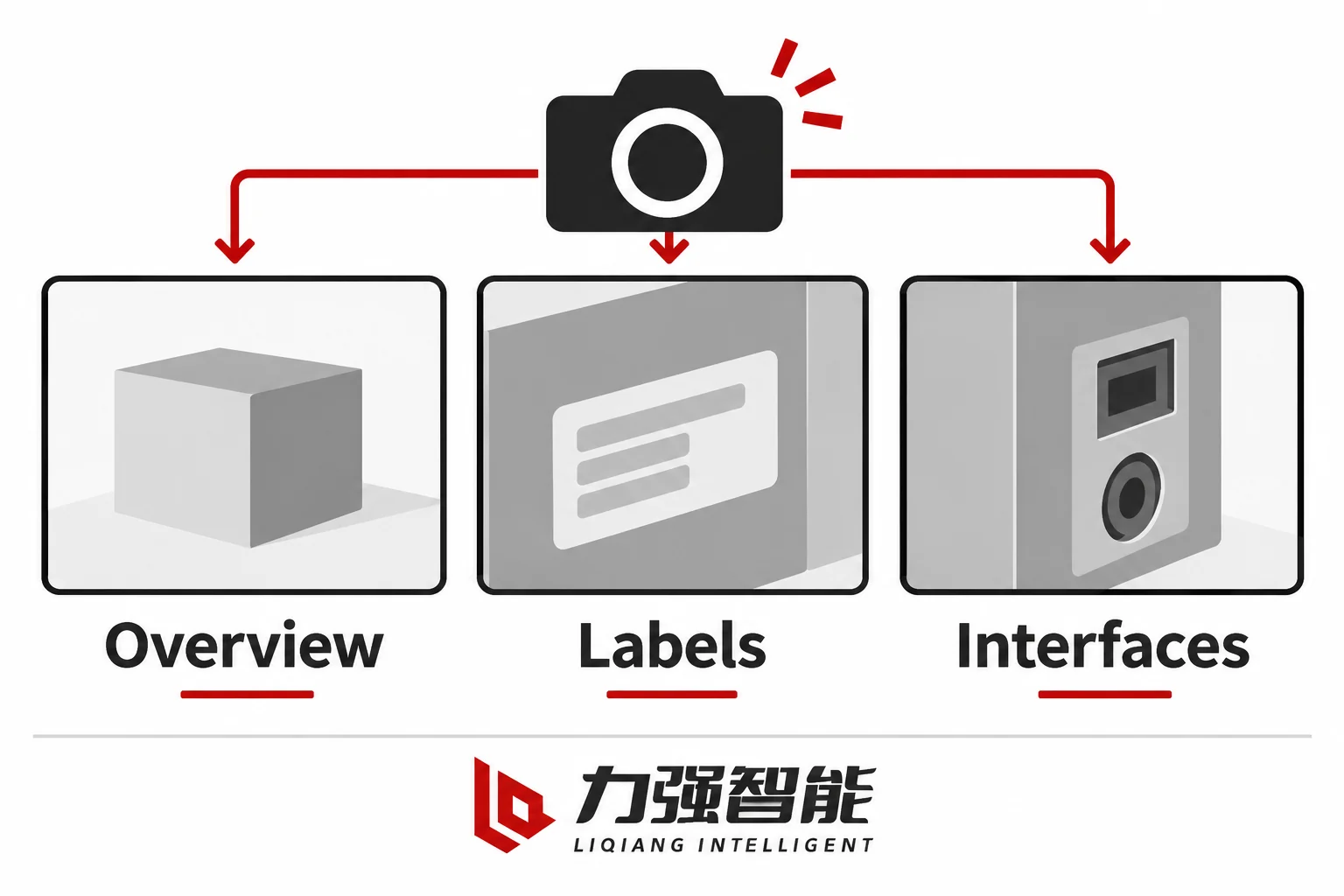
Укажите для каждой имеющейся фотографии конкретное назначение и номер снимка. На этих абстрактных снимках не видно ни реального оборудования, ни разборчивой таблички с наименованием.
Виды этикеток для выключателя и шкафа
Цель этих снимков — зафиксировать читаемые данные с заводской таблички. Сфотографируйте заводскую табличку выключателя и любые идентификационные этикетки на шкафу так, чтобы текст был достаточно крупным и разборчивым на снимке. Если заводская табличка частично закрыта или повреждена, сфотографируйте ту часть, которая читается, и в запросе четко укажите, какие поля нечитаемы. Частично читаемая табличка с техническими данными полезнее, чем её отсутствие, — но её необходимо представить как неполную, а не считать полной.
Укажите ссылки на вторичное размещение и маркировку встроенных компонентов, если они уже задокументированы или могут быть зарегистрированы в рамках утвержденного объема проверки. Четко указывайте на отсутствующие или неразборчивые маркировки, а не пытайтесь восстановить недостающие данные.
Виды всей сборки и расположения деталей
Эти виды позволяют определить общий тип компоновки (фиксированная, выдвижная, боковая) и ориентацию основных и вспомогательных интерфейсов относительно шкафа. Обзорная фотография помогает поставщику убедиться, что видимая компоновка соответствует обозначению модели на заводской табличке, а также выявить очевидные несоответствия — например, если заводская табличка указывает на выдвижной блок в панели, которая, судя по всему, не имеет монтажных рельсов.
На имеющемся общем виде должны быть указаны расположение устройства и его место в шкафу. Если это указано в документации, следует указать местоположение вторичной сборки относительно выключателя и указать направление обзора. Отсутствующий вид остается предметом запроса.
Виды контекста интерфейса
Если на имеющихся или утвержденных контрольных изображениях показаны первичный интерфейс и вторичные соединительные элементы, приложите их вместе с соответствующим видом. Такие изображения помогают в идентификации и при подготовке следующего запроса на чертеж; они не подтверждают скрытую геометрию или назначения цепей. Именно по этой причине на странице ZN85-40.5 конкретно запрашивается информация о шкафу и монтаже, первичных контактных и монтажных интерфейсах, ориентации вторичных разъемов и согласованной схеме подключения: эти данные определяют, будет ли предлагаемая конфигурация физически подходить и правильно подключаться.
К каждой фотографии следует прикрепить четыре элемента метаданных: идентификатор единицы или номер панели, направление съемки или описание, дату съемки и имя автора (инженер на объекте, подрядчик, сборщик панелей). Эта контекстная информация имеет важное значение при рассмотрении фотографий несколько недель спустя в ходе технического обсуждения.
Другие записи
Наряду с фотографиями соберите все другие соответствующие документы, которые удастся найти, и приложите их с четким указанием статуса (версии или даты): листы настроек реле защиты (с указанием соответствующего контекста управления и защиты, при этом рабочие требования должны быть подтверждены отдельно), записи о модификациях щитов, любые протоколы ввода в эксплуатацию или испытаний, в которых упоминается вторичная проводка, а также журнал истории технического обслуживания. Протокол ввода в эксплуатацию, в котором указано источник питания катушки срабатывания, служит отслеживаемой исторической точкой данных; прежде чем считать текущий источник питания подтвержденным, проверьте, остается ли он актуальным после каких-либо модификаций. Запись о модификации, в которой отмечается, что вторичный разъем был переподключен во время модернизации реле, является критически важной информацией, которую не может предоставить заводская табличка.
Подробные проверки первичной геометрии и сопоставление функций вторичных разъемов рассматриваются в материалах по проверке размеров и совместимости вторичных разъемов — в запросе на поставку необходимо указать неизвестные моменты в этих областях и запросить соответствующую документацию у поставщика, а не пытаться решить эти вопросы, опираясь исключительно на фотографии.
Превратите каждый недостающий элемент в конкретный вопрос и назначьте ответственное лицо
A gap list is only useful when each item is specific enough to be acted on. “Missing drawings” is not a gap — it is a description of the overall problem. A gap entry needs to identify exactly what is missing, what evidence currently exists in its place, what the consequence is for the proposed replacement, what specific record or verification would close it, who is responsible for obtaining it, and what the current status is.
Превратите отсутствующую запись в конкретный запрос с указанием ответственного лица и следующих необходимых данных.
В приведенной ниже таблице представлена эта структура. Перечисленные пункты отражают типичные пробелы, возникающие при замене устаревшего оборудования; они не взяты из какого-либо конкретного проекта.
Отсутствующий товар
Имеющиеся данные
Последствия замены
Необходимая запись или подтверждение
Action owner
Status
Secondary wiring schedule (as-built)
Original issue drawing found, revision unknown; no commissioning red-line
Cannot confirm trip/close/motor supply or auxiliary contact allocation
As-built wiring schedule from panel builder, or controlled qualified verification of actual wiring
Site engineering / panel builder
Open
Full nameplate model designation
Partially legible photograph; family prefix readable, current rating field obscured
Full designation and the obscured rating remain unconfirmed
Legible nameplate photograph or site inspection by qualified person
Site maintenance team
Open
Cabinet outline drawing (internal)
Panel builder name visible; no drawing reference number
Primary contact geometry and racking travel unconfirmed
Applicable cabinet drawing, verified against the installed configuration
Panel builder
Open
Present fault level at bus
Original protection study located, dated ten years ago
Breaking rating requirement unconfirmed for present network
Current fault level schedule from network operator or updated protection study
Design engineer / network operator
Open
Applied standard and edition
Not stated in available records
Applicable type test documentation scope unknown
Confirm applicable standard with project or site engineer
Responsible design engineer
Open
Note the distinctions that matter when building this register. A genuinely absent record (the wiring schedule was never filed on this site), an illegible copy (the nameplate photograph is blurred), an inapplicable revision (the drawing found is for a different panel serial), and a conflict with fitted equipment (the drawing shows a fixed arrangement but the panel appears withdrawable) are four different situations with different recovery paths and different implications for the enquiry. Collapsing them into “drawings missing” loses that information.
An unverified scan of a similar unit’s drawing is not an approved as-built. A drawing from a panel of the same type but different serial number is not confirmed as applicable to the retained unit. Label proposed assumptions explicitly rather than presenting them as confirmed inputs.
Recovery paths for gap closure are realistic rather than guaranteed. The panel builder may no longer be trading. The site commissioning records may have been lost in a relocation. A current fault-level enquiry may also depend on another organisation’s response. Naming the recovery path establishes who needs to act and creates a visible record of what has been tried — it does not promise the record will be found.
Send a Structured Enquiry With Clear Quote Boundaries
Once you have organised the available evidence and built the gap register, the enquiry itself should be short, grouped and explicit about what it is asking the supplier to do. The objective is not to present a complete technical package — it is to give the supplier enough organised information to respond with specific technical questions, a candidate configuration and a clear statement of what assumptions or unknowns affect their ability to quote.
A conditional quote scope and an engineering release record answer different questions. The symbols are conceptual record states.
The following outline provides a usable starting structure. Fill the bracketed fields with available project information and its source; mark unavailable or unconfirmed fields explicitly as unknown.
VCB Replacement Enquiry — Initial Package
1. Replacement objective
We are seeking a replacement indoor vacuum circuit breaker for the unit identified below. The retained cabinet will remain in service; the replacement must be mechanically and electrically compatible with the existing panel interfaces as confirmed through the enquiry process.
2. Installed unit identity
– Full model designation (from nameplate): [state readable fields; note illegible fields explicitly]
– Serial number: [if available]
– Cabinet reference / panel builder: [state available information]
– Commission date: [if known]
– Arrangement type: [withdrawable / fixed / side-mounted, as observed]
– Photographs attached: [list views provided, with date and source]
3. Present duty and site conditions
– System operating voltage and required equipment voltage / insulation class: [state each known requirement and source, or unknown]
– Required continuous current: [A, and source of this figure]
– Required short-circuit breaking current: [kA, and source — network study, operator schedule, or unknown]
– Service conditions: [indoor, altitude, temperature range, pollution degree if known]
– Other required duty: [frequency, withstand and operating-duty requirements from the applicable project specification, or unknown]
– Note: [state any duty items that are not confirmed from current data]
4. Retained interfaces
State the fitted mechanism and control arrangement. Complete the load fields that apply; mark a field not applicable only when the selected configuration records establish that it is absent.
Primary arrangement: [describe what is observable; note unconfirmed dimensions]
Secondary connector: [housing type and orientation if identifiable; state if unknown]
Trip coil supply: [V DC/AC if confirmed; state source or note as unknown]
Close coil supply: [V DC/AC if confirmed; state source or note as unknown]
Motor charging supply: [V DC/AC if confirmed; state source or note as unknown]
Auxiliary contact requirements: [if known from relay list or protection schedule]
Interlocks: [describe any visible or documented interlocks]
5. Supplied evidence
[List each attached document with its revision or date status, and note which gaps it leaves open. Example: “Secondary schematic Issue 1, 1998 — revision status unconfirmed, no commissioning red-line.”]
6. Open gaps
[Attach the gap register from the previous section, or summarise the critical items here.]
7. Quantity and destination
– Quantity: [number of units]
– Site and country: [location]
– Required project documentation: [outline drawing, schematic, test certificates — state what is needed]
8. Requested supplier response
Please advise:
– Which proposed configuration(s) could address this replacement, and which arrangement/option fields apply
– Which drawing revisions cover the identified configuration and the retained panel
– Which of the open gaps affect your ability to confirm compatibility or price this enquiry
– Which additional information you require from us before proceeding
A response to this enquiry may enable a conditional budgetary discussion — an indicative price range and lead time based on the most probable configuration, subject to resolution of the open gaps. That is useful for budget planning. It is not a configuration-confirmed order release. The gap between a budgetary indication and an order release is where the real interface verification work happens.
To understand why that distinction matters in practice, consider this scenario. A panel engineer is replacing a breaker in a withdrawable switchboard from an original installation for which the panel builder no longer holds records. The breaker nameplate is readable and the overview photographs clearly show the withdrawable arrangement with the secondary plug housing on the left side. There is no secondary wiring schedule — the commissioning engineer left the company and the records were not archived. The engineer sends the structured enquiry as above, with the wiring schedule gap explicitly noted.
The supplier can proceed with candidate identification based on the nameplate and photographs. They can propose a candidate configuration and provide its applicable outline drawing for primary interface review. But they cannot confirm the secondary wiring compatibility, and they say so explicitly. If the supplier can define a meaningful provisional scope, a budgetary discussion may proceed with its price and delivery assumptions stated. The missing interface must remain unresolved until verified. The order cannot be released until the wiring schedule is recovered or a controlled as-built verification is carried out by a qualified person under appropriate isolation. The enquiry has done its job: it has separated what can be assessed now from what still needs to be resolved.
Critical gaps — ones where the supplier explicitly states that the unknown prevents a meaningful quotation — are different from gaps that affect only the final order confirmation. If the voltage requirement, arrangement and primary interface are all unknown, the available information may not support a meaningful candidate or quotation. Prioritise record recovery or a qualified identification assessment to establish the missing inputs. A structured enquiry exposes that earlier rather than later.
Close the Configuration Record Before Replacement Approval
A supplier’s response to the structured enquiry should return specific, not generic, information. The useful elements are: the exact proposed model designation and its option list; the applicable outline drawing reference and revision; the applicable secondary schematic reference and revision; and an explicit statement of which provisional assumptions underpin the offered scope, which evidence supports them and which gaps remain open.
Receiving a response is not the same as closing the configuration record. Agreeing on ratings or confirming a matching model prefix does not close the interface questions. An offered configuration for a VS1-24 withdrawable unit in a particular racking arrangement, with a specific secondary connector housing and a stated operating supply, is a specific configuration. A VS1-24 family reference without those fields is not.
Verify that the drawing revisions offered actually cover the retained panel and the proposed unit, not the product family in general. A generic outline drawing for the VS1-12 family may show the overall envelope dimensions correctly while being wrong on the secondary connector housing position for a specific arrangement. The VS1-12 page notes that gallery, outline and circuit references may belong to different arrangements — this is exactly why confirming which revision applies to which arrangement is a necessary step before final order release.
The documentation scope requested for the enquiry response should match the identified configuration. Type-test reports identify a tested sample, configuration and scope; requested routine or inspection records should identify the supplied equipment and agreed checks. These are distinct from the outline and schematic for the offered configuration. Confirm what is available now and what must be supplied with the order. Requesting a test certificate for “the VS1-24 family” without specifying the rating, standard edition and applicable configuration does not close the documentation requirement for your project. The indoor product family pages make this explicit: drawings and test-report scope must match the identified configuration, not every family variant.
What closes the replacement enquiry — meaning what allows order release — is the combination of: a specific offered configuration with applicable drawing pair verified against the retained panel and the proposed unit; critical duty and interface gaps resolved through applicable records, controlled verification or an approved design solution; and the required documentation scope and delivery obligations agreed for the named configuration. Provisional quotation assumptions do not replace verification of a required compatibility condition.
For the primary contact geometry and mounting dimension verification, the detailed review belongs to the dimensional resource. For the secondary connector function mapping, the detailed verification belongs to the secondary plug compatibility resource. The enquiry package establishes that those checks are needed and ensures the supplier knows which information to provide — but it does not substitute for them.
Next Steps and Further Reading
When you are ready to submit a replacement enquiry for an indoor vacuum circuit breaker, the indoor VCB product and configuration page is the right starting point for identifying candidate models and requesting configuration-specific documentation.
For the operating supply and load supply questions that arise when the wiring schedule is partially known, the control voltage detail resource covers those inputs separately.
If the secondary connector is a primary gap — housing type, orientation and function mapping are all unknown — the secondary plug compatibility resource covers that verification in detail.
Once a candidate configuration is identified, the primary interface dimensional check should follow the installation dimensions resource.
To submit a traceable replacement enquiry with the structure described in this article, use the enquiry and contact page.
Часто задаваемые вопросы
Can I send a replacement enquiry before the secondary wiring schedule is recovered?
Yes, when the known information and the missing items are stated clearly. An enquiry that clearly identifies the installed unit, states the known duty, provides available photographs and records, and lists the wiring schedule as an explicit open gap is more actionable than one that waits indefinitely for a document that may not be recoverable. The supplier can explain whether the available information supports candidate identification or a provisional scope, and what is needed next. What the wiring schedule gap prevents is functional compatibility confirmation and final order release. The gap register makes that boundary visible for both parties. Sending the enquiry earlier exposes whether the wiring schedule is a critical blocker or a parallel workstream item — it does not delay that determination.
Does agreeing on the rated voltage and current mean the replacement will fit my panel?
No. Ratings describe stated capabilities for the identified configuration; the relevant duty and supporting evidence still need to be checked. They do not establish that the primary contact geometry, racking travel, shutter mechanism or secondary connector housing of the proposed unit match your retained panel. Two withdrawable VCBs with identical rated voltage and current can have different contact centre distances, different racking depths, different secondary connector positions and different secondary housing types. Applicable outline and primary-interface design records, checked against the retained assembly and approved limits, support the dimensional decision. The secondary functional record must also reconcile the selected circuit with the actual retained wiring. Neither an outline alone nor a schematic of a different configuration closes the whole replacement assessment. Ratings and model prefix are starting points for candidate identification, not finishing points for compatibility approval.
What if the panel builder’s records are no longer available and the wiring schedule cannot be recovered?
When records cannot be recovered through the panel builder or site archives, one possible recovery path is controlled verification of the installed interface by the responsible qualified engineering team. The engineering scope should establish a verified as-built record under the site’s authorised access and safety controls. If the required interface cannot be established, the responsible designer must decide the appropriate replacement or redesign scope. That work is outside the scope of the replacement enquiry process itself — it is a separate engineering activity that must be planned, authorised and executed before the secondary interface can be confirmed. The enquiry package should note this as the required path when the wiring schedule gap cannot be closed through document recovery, and the responsible design engineer should be named as the owner of that action.
Поделитесь своей любовью
Уильям Сяонань Лю
Уильям Сяонань Лю пишет для сайта LIQELE о коммутационном оборудовании среднего напряжения, в том числе о вакуумных выключателях, выключателях под нагрузкой, разъединителях и заземляющих выключателях. В своих статьях он рассказывает о выборе продукции, требованиях к монтажу, условиях эксплуатации и технической документации, помогая производителям коммутационного оборудования и заказчикам проектов определить информацию, необходимую для подбора оборудования и переговоров с поставщиками.
Внутренние вакуумные автоматические выключателиУстановка панелейСравните конструкции и интерфейсы шкафов.Стационарный / съемныйКомнатные распределительные устройстваНапольная установкаТрехпозиционная схемаСреднее расположениеВакуумные автоматические выключатели для наружной установкиРаспределительные фидерыПроанализируйте схемы подачи, датчиков и управления.Переключение питающего источника / границыРаспределение на открытом воздухеВыключатели нагрузкиКоммутация и интеграция в шкафыСравните режимы работы выключателей и схемы размещения в шкафу.Реле нагрузки с пневматическим срабатываниемВакуумный выключатель нагрузкиРасположение встроенных полюсовРазъединители и заземляющие выключателиИзоляция и заземлениеПроверить меры по изоляции, заземлению и рабочие интерфейсы.Внутренний разъединительРотационный разъединитель для внутренней установкиВнутренний заземляющий выключательВыдвижной вакуумный выключатель VS1-12 со встроенными полюсамиУзел наружного вакуумного автоматического выключателя ZW32-12 с разъединителемКомплект вакуумного выключателя нагрузки для внутренней установки FZN25Узел поворотного внутреннего разъединителя GN30-12VS1-24 — вакуумный автоматический выключатель для установки в помещенииТиповая конфигурация автоматического выключателя ZN85-40.5 для внутренних сетейВид спереди на трехпозиционный вакуумный автоматический выключатель VQL-12 для установки в помещенииВакуумный выключатель VQL-24GD/630-25Типовая конфигурация трёхпозиционного выключателя VQLA-12 со средним расположениемТиповая конфигурация вакуумного выключателя ZW20 для наружной установкиТиповая конфигурация выключателя нагрузки FKN12Вакуумный выключатель нагрузки FZN64-12GDВыключатель нагрузки со встроенным полюсом VZF, вид сзадиВнутренний разъединитель GN19-12, вид спередиВнутренний разъединитель GN27-40.5, вид спередиТиповая конфигурация внутреннего заземляющего выключателя JN15Ассортимент продукцииТиповая конфигурацияВ центре внимания: продуктПосмотреть все товарыОбсудите свои требованияКаталог серийПросмотреть категориюКатегории товаровТиповая конфигурация продуктаПереключить ассортимент продукцииLIQ: Основная навигацияЗапросить расценкиЗапросить расценки