Type-Test Reports, Factory Inspection Records and ISO Certificates: What Each Proves
Approx. 14 min read
Quick Takeaway
A type-test report addresses a submitted design or sample configuration under specified test conditions. Keep the sample description, technical data and test items together; a shared model prefix does not automatically extend the report to every variant or fuse combination.
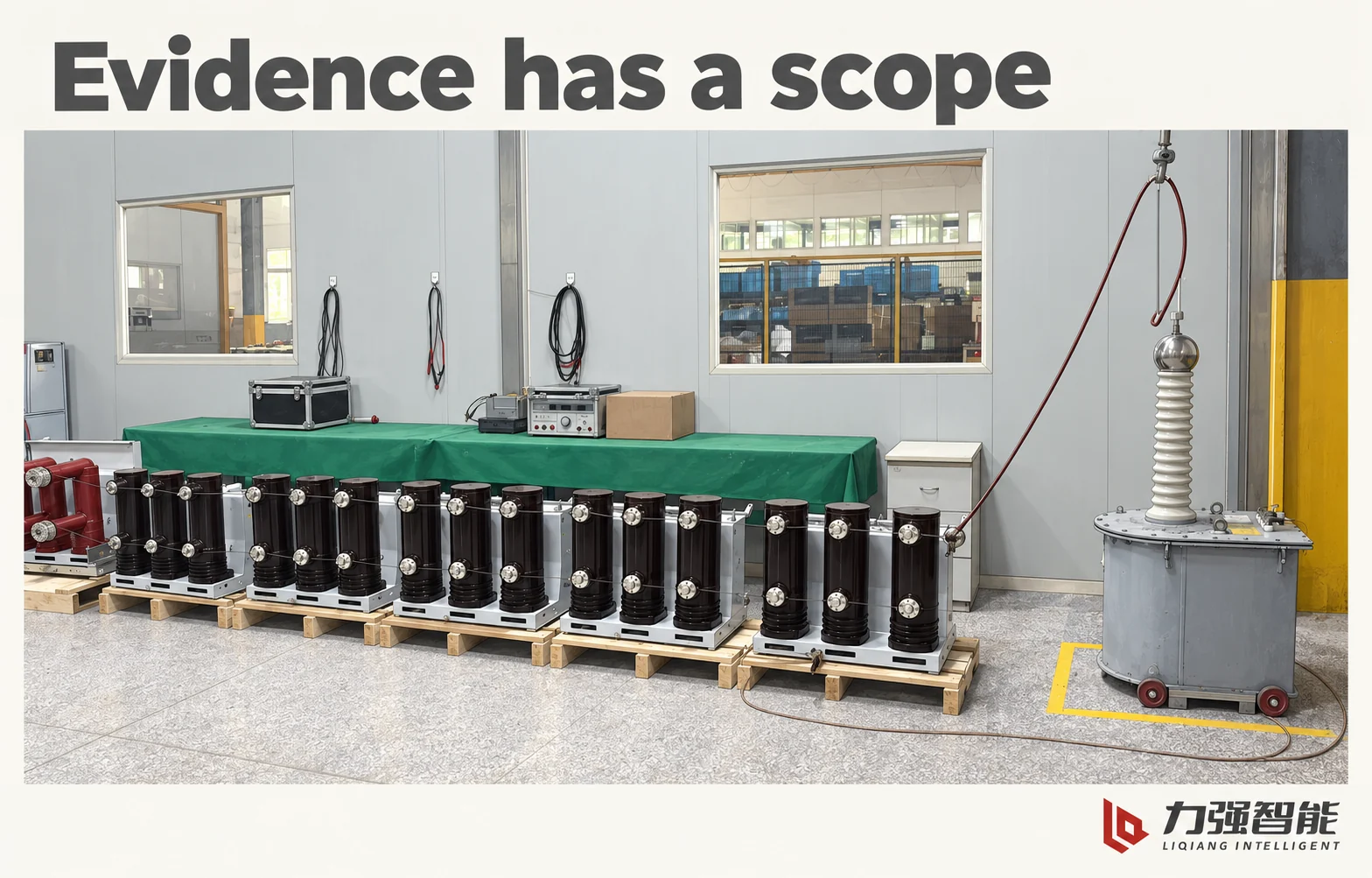
A completed factory inspection record follows identified units or a defined batch, the checks performed and their recorded results or observations. A procedure describes how to inspect; it does not supply a completed delivery result. Per-unit checks, sampled items and any separately agreed factory acceptance test retain their own coverage.
An ISO management-system certificate addresses the named organization, sites and activities within its scope. It complements design and delivery records rather than replacing them. Organize an order around those three associations: offered configuration, delivered equipment identity, and manufacturer entity and site.
A type-test report proves something about a tested design: one submitted sample or defined set of samples, in a particular configuration, subjected to stated tests under stated conditions. A factory inspection record proves something about identified production equipment: the unit or batch that was checked, the items actually checked, what was measured or observed, and how the result was judged. An ISO certificate of the kind normally filed with those two documents is a management-system certificate — ISO 9001 is the usual example — and it proves something about a named organization: the system it uses to manage the activities within a stated scope.
Design, delivery, organization. That is the entire distinction, and it is also why the three documents cannot be treated as a bundle of equivalent stamps. Each one speaks about a different object, at a different moment in the life of the equipment.
Equipment, design evidence, delivery records and organization-level statements answer different questions. Keep each document's object and scope attached to its conclusion.
Document
Object it describes
Procurement question it answers
Useful output
Type-test report
A submitted sample or design in a defined configuration, under stated test conditions
Can this design be shown to perform a specified duty?
Recorded test items, conditions and results tied to a named sample and configuration
Factory inspection record
Identified production units, or a defined batch
What was checked on the items being shipped, and what did those checks show?
Check items performed, recorded data or observations, acceptance conclusion, equipment identity, date and responsible function
ISO management-system certificate
A named organization, its sites and its activities, within a stated scope
Does the manufacturer run a managed, repeatable system for the activities in question?
A scope statement linking the certified system to an organization and a defined set of activities
This three-way division is not unique to any one maker. ABB’s published VD4 technical specification separates type tests, routine tests and factory quality-system material into distinct sections (ABB VD4 technical specification) — a manufacturer’s specification, not a test result, but a clear illustration of the same structure seen from the supplier’s side: design qualification tasks such as temperature rise, dielectric behaviour, mechanical operation and switching duty; production checks for which a report can be provided per breaker; and management-system documentation for the organization that builds them.
What a type-test report proves about the tested design
Design qualification tests assess specified characteristics of a construction under defined conditions, using the required representative samples and test arrangements. Short-circuit duties, temperature rise, dielectric performance and mechanical behaviour ask different questions about that construction. Production checks do not repeat the entire design-qualification programme, although some subjects, including dielectric and mechanical checks, can appear in both programmes with their applicable requirements. The type-test evidence stays linked to the sample description, configuration and conditions under which each test ran.
That is why the useful reading order inside a report runs: document identity first, then the sample description, then the sample’s technical data and rating basis, then the list of test items with their conditions and results. The supplied FKRN switch-fuse-combination report is laid out exactly that way — its opening pages separate the identity and description of the submitted object from the sample’s technical data, and present the test items, conditions and results as a later block. Its entries address several different kinds of design question, among them insulation, mechanical and interlock behaviour, switching and making duty, and impedance with temperature rise. Each of those entries belongs to the sample it was performed on.
For a procurement review, the sample description is the load-bearing field. A report on a switch-fuse combination describes a combination: the switch and the fuse that were tested together, at stated values and with a stated construction. It does not automatically become a report on a bare switch from the same family, nor on a combination fitted with a different fuse, nor on the same device in a different mounting arrangement. When a supplier offers a variant, the reasonable request is not simply “another report” but a stated technical basis — which characteristics of the tested configuration are unchanged, and under which document the difference is addressed. A shared model prefix or membership of the same product family is a naming convention, not a coverage argument.
It is also worth seeing why the design evidence sits apart from production checks in the first place. Type tests assess the design characteristics addressed by the specified programme. Production checks assess the required characteristics of manufactured equipment and its conformity, without repeating every design test. The two programmes can share subjects while answering different questions. Collapsing them into a single “tested” claim loses both.
The tested configuration and conditions define the starting point. The technical basis for coverage must address the offered variant and its differences.
What a factory inspection record proves about delivered equipment
A production check answers a different question from a design test: whether this particular unit, or the units in this batch, were built and assembled so as to conform to the qualified design, and whether the checks performed on them met their acceptance criteria.
A completed record is consequently a three-way relationship — equipment identity, check items performed, and recorded data or observations with an acceptance conclusion. Identity is what joins the record to the equipment on the pallet: a record with no unit or batch reference, or a delivery with no matching identity on the nameplate, leaves the two halves unconnected. The record should identify the check and retain the data or observations its acceptance basis requires. A resistance check may need a measured value; a visual or functional check may use an observation or a defined pass/fail result. That detail explains what was covered without treating every inspection item as a numerical measurement.
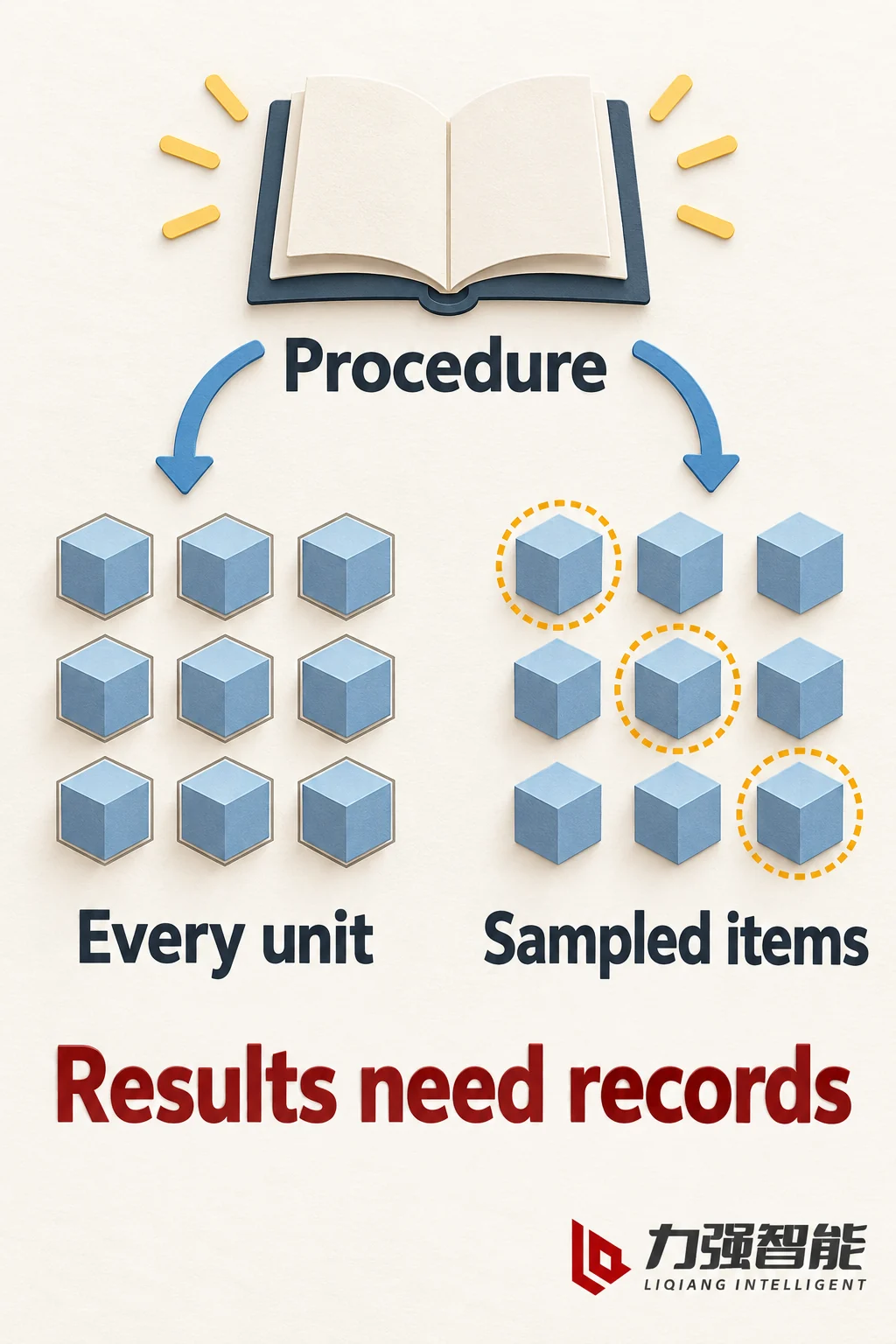
Liqiang’s supplied breaker finished-product inspection procedure shows how a procedure is organized. It separates checks carried out on every unit from items handled by sampling and reinspection, and it requires the record data to agree with the report accompanying the product, together with nameplate identity and the documents that ship with the equipment. Those are procedural requirements: they describe how the work is done and recorded. A completed record is a different artifact — it states what was actually found for its own identity. Keeping the two apart is practical, because the procedure tells you the shape of the record you should expect, while only the completed record tells you the result.
Sampling changes how a record relates to the delivery. If a procedure states that an item is verified on a sample of production, then a delivery covering a large batch may legitimately contain that item’s results for a defined subset of units rather than for every one. The applicable inspection plan defines those sampled items and the units included. For the buyer, the useful question is which checks the record covers and how that coverage relates to the delivery. Routine items and sampled items are both recorded; they are not the same population, and a record read without that distinction can overstate or understate what was verified.
“Factory inspection” is itself a broad phrase, and its recorded scope is what counts. Where a factory acceptance test is separately agreed for an order, it has its own agreed scope, its own participation arrangements and its own recorded result, and it belongs in the folder as a separate item rather than being inferred from the routine inspection.
An inspection plan assigns the relevant per-unit and sampled checks. Completed records still need to retain the results and the equipment population those checks cover.
What an ISO management-system certificate proves about the organization
ISO 9001 is a quality-management system standard. Its object is the organization — how it manages the processes that deliver its products, and how it improves them over time — rather than any individual product characteristic. ISO’s own description of the standard family places the emphasis on the organization’s quality management, its processes and continual improvement (ISO 9000 family).
A certificate issued against such a standard is a statement about a named organization within a stated scope. The certificate statement normally identifies the certified legal entity, its site or sites and the activities covered, alongside the reference standard and the certifying body. In a procurement folder, the scope statement is the part that carries the value: it answers the question “which manufacturer, at which site, doing which work, is covered by this system?”
The contribution this makes to an equipment order is real but indirect. Quality-system arrangements help make the handling of these documents repeatable — controlled document versions, controlled suppliers, traceable calibration of measuring instruments, defined handling of nonconforming output, corrective action, internal audit and management review. Without those arrangements, a type-test report can end up as an isolated exercise and production records can drift in format and content from one batch to the next. With them, the evidence the organization produces stands on a process rather than on the diligence of individuals.
What the certificate does not carry is electrical performance. Insulation withstand, temperature rise, mechanical endurance and switching duty are design statements, and they live in the type-test evidence for the design in question. Whether a delivered unit met its acceptance criteria is a production statement, and it lives in the completed unit or batch record. A scope phrased as “manufacture of switchgear” says nothing about a specific model’s interruption capability, and the corresponding model’s performance question belongs with its design-test evidence.
One point about who is speaking is worth keeping straight. ISO as an organization develops standards; it does not audit or certify companies and does not issue their certificates. Certification is performed by external certification bodies, and the certificate in a folder names the body that performed it (ISO certification). That is a matter of reading the issuer field correctly, not a separate procurement test.
Read a management-system statement for the named entity, the site and the activities within its scope. These are organization-level associations.
Organizing the three documents around one equipment order
Consider an indoor, 12 kV-class distribution project in which one switchgear lineup contains feeders that need a withdrawable vacuum circuit breaker and, alongside them, transformer feeders protected by a switch-fuse branch. The buyer has chosen arrangements from the supplier’s catalogue — a withdrawable breaker configuration and a switch-fuse combination — and now has to assemble the evidence set for the purchase order.
The first question is per configuration, not per order. For the withdrawable breaker, the design question is whether the type-test evidence covers the offered construction: the pole and insulation arrangement, the mechanism type, and the rated combination proposed for those particular feeders. Where the offer sits inside a family such as the VS1-12 line, the report to request is the one whose sample description matches that construction, and the accompanying question is how any other configuration in the offer is covered. For the switch-fuse branch, the tested object is the combination — switch and fuse together — so the design question includes the fuse combination. A branch that later switches to a different fuse rating, or to a different switch family, asks a new question, even when the electrical duty at the panel looks similar. The FKN12 family and the FZN25 family are separate starting points for that request, and deciding which one suits a given feeder is a task in its own right (selecting medium-voltage switching devices).
The second question is about identity. Once the order is placed and the supplier knows how the delivery will be split into production runs, the production records have to be associated with the units actually shipped. The useful identifier is whatever appears both on the equipment and in the record: a unit serial number, or a defined batch reference with the range of units it covers. If the delivery is built in two runs, two record associations exist even though the design evidence is unchanged. Nothing about the type-test position moves; what changes is which record answers for which crate.
The third question is about the organization. The manufacturer’s system evidence has to be read for the entity, site and activities that actually produce the ordered equipment. Where a supplier group operates more than one legal entity or production site, a scope statement naming a different site is a mismatch worth resolving before the order is placed, not after the equipment arrives.
Organize the order folder around these three questions:
Configuration and design evidence — the arrangement as offered (mounting style, pole construction, mechanism, fuse combination where applicable, proposed rated combination) placed next to the type-test evidence for that configuration, with a note on how any other proposed variant is covered.
Delivery evidence — the unit identities or batch reference in the delivery, together with the completed inspection record for those identities, listing the check items performed, the recorded data or observations, and the acceptance conclusion.
Organization evidence — the management-system certificate scope statement naming the manufacturer entity and the site or activities that produce the equipment.
One index line per item — offered configuration, unit identity, entity and site — is what makes the folder usable later, at the moment someone has to answer a question about one delivered piece of equipment rather than about the order as a whole.
With the offered design unchanged, two delivery runs retain their own equipment identities and production-record associations. A separately agreed FAT has its own scope and record.
What to request, question by question
Framing the request in three parts keeps it short and keeps the answers usable.
For the design question, state the equipment designation and the selected arrangement in enough detail to identify it — mounting style, pole or insulation construction, mechanism, fuse combination where relevant, and the proposed rated combination — then ask for the type-test evidence whose sample and conditions correspond to that arrangement. Where the offer contains more than one configuration, ask separately how each one is covered instead of assuming the family covers all of them.
For the delivery question, ask for the completed inspection record for the specific unit identities or the defined batch in the delivery, and ask for the check items and recorded results rather than a conformity statement alone. If a factory acceptance test forms part of the commercial agreement, treat its scope and its record as separate items in the same request.
For the organization question, ask for the management-system certificate scope statement that names the manufacturer entity and the site where the ordered equipment is produced, and read the activities covered rather than the certificate’s title.
Liqiang’s own routes are the place to start assembling that file. Start with the available product documents in technical downloads, then request the files corresponding to the selected equipment and order. The company information page sets out the manufacturing context those documents belong to. Model pages such as VS1-12, FKN12 and FZN25 give the configuration starting points for the first part of the request. Where the remaining task is choosing between duties and arrangements, continue with the switching-device selection guide; where the question is how the equipment itself is built, the vacuum circuit breaker manufacturing overview is the adjacent read.
Used in their three slots, a type-test report, a factory inspection record and a management-system certificate each answer the question they were made for, and none of them has to stand in for the other two.
FAQ
Does an ISO 9001 certificate replace a type-test report?
No. The management-system certificate concerns the named organization and the activities and sites within its scope. A type-test report addresses the submitted design or samples, their configuration and the specified tests and conditions. The organization-level statement does not supply a switching device’s insulation, temperature-rise or interruption results. The two documents answer complementary procurement questions.
Does splitting an order into two production runs automatically require another type test?
No. Splitting the delivery changes which production records belong to which identified units or batches; it does not by itself change the design. The design evidence remains associated with the applicable configuration, while the completed production records follow each run’s actual identities and checks. If the construction or specified combination changes as well, its relationship to the tested configuration needs to be addressed separately.
Must every factory inspection result be a numerical measurement?
No. The record should retain the result that the check’s acceptance basis requires. A resistance check may require a measured value, while a visual or functional check may use an observation or a defined pass/fail result. In either case, connect the result to the identified equipment, the check performed and its acceptance conclusion, including the applicable unit or sampling coverage.
Share your love
William Xiaonan Liu
William Xiaonan Liu writes for LIQELE about medium-voltage switching equipment, including vacuum circuit breakers, load break switches, disconnectors and earthing switches. His articles explain product selection, installation interfaces, operating requirements and technical documentation, helping switchgear builders and project buyers identify the information needed for equipment selection and supplier discussions.